
Buyers pay in full, take possession of their property, and live there for years, only to discover later that their transaction was never legally completed because Governor's Consent was not obtained. When that happens, the transaction is legally void, and the consequences can be devastating.
Leisure Court Editorial Team
Real Estate and Property Development, Nigeria
Leisure Court has been developing affordable residential estates across Abuja, Lagos, Akure and Osogbo for over 7 years. Our team writes to help Nigerian buyers make informed real estate decisions.
This article explains exactly what Governor's Consent is, when it is required, how to obtain it, and why no property transfer in Nigeria is complete without it.
What Is Governor's Consent?
Under the Land Use Act of 1978, all land in Nigeria is vested in the State Governor. This means that when a property with a Certificate of Occupancy (C of O) changes hands, the Governor must formally consent to that transfer.
Governor's Consent is the official document that records that consent. It is essentially the state's approval that the sale or transfer of the property is legally recognised.
Without it, the transfer does not exist in the eyes of the law, regardless of how much money changed hands, what agreements were signed, or how long the buyer has been in possession.
Working with a trusted real estate developer in Nigeria means this step is built into the transaction process. Private purchases, however, frequently leave buyers without it.
When Is Governor's Consent Required?
Governor's Consent is required every time a property with an existing Certificate of Occupancy is:
- Sold — from one individual or company to another
- Gifted — even between family members
- Mortgaged — used as collateral for a bank loan
- Assigned — transferred as part of a business transaction
- Inherited — passed to heirs on the death of the titleholder
It is not required for the first grant of a C of O (since the Governor is issuing it directly), but it applies to every subsequent transaction involving that title.
In Abuja (FCT), the equivalent document is called Minister's Consent, issued by the FCT Minister, and it operates in exactly the same way.
What Happens If Governor's Consent Is Not Obtained?
The legal consequences are serious:
The transfer is void. Section 22 of the Land Use Act is explicit: any transaction that purports to alienate land without the Governor's prior consent is null and void. The buyer has no legal title, regardless of what they paid.
The property cannot be used as collateral. Banks will not accept a property as loan security if Governor's Consent has not been obtained for the current owner's title. This can lock you out of mortgage financing entirely.
Future sales become complicated. When you try to sell the property, the absence of Governor's Consent creates a gap in the title chain that makes the property difficult or impossible to sell to an informed buyer.
Legal disputes become expensive. If the original seller disputes the transaction, or if their estate contests it after their death, you will be in court without a legally complete title to defend.
How to Obtain Governor's Consent in Lagos
The process varies slightly by state, but Lagos is the most commonly navigated. Here is the standard process:
Step 1: Prepare the Application The buyer (or their lawyer) prepares a formal application for Governor's Consent, accompanied by the following documents:
- Original C of O of the property
- Executed Deed of Assignment or Transfer
- Current tax clearance certificates of both buyer and seller
- Stamped and assessed Deed (from the Lagos Internal Revenue Service)
- Survey plan of the property
- Evidence of payment of the consent fee
Step 2: Pay the Consent Fee Lagos State charges a Governor's Consent fee of 3% of the property value (as assessed by the state). This is a significant cost to budget for and should be factored in at the time of purchase negotiation.
Step 3: Submit to the Lagos Lands Bureau The application is submitted to the Lagos State Lands Bureau at Alausa, Ikeja. Processing times vary but typically run between 30 and 90 days for straightforward applications.
Step 4: Stamp Duty and Registration Once consent is granted, the Deed must be stamped (stamp duty of 1.5% of the purchase price) and registered at the Land Registry. Only at this point is the transaction legally complete.
Governor's Consent Fees: What to Budget
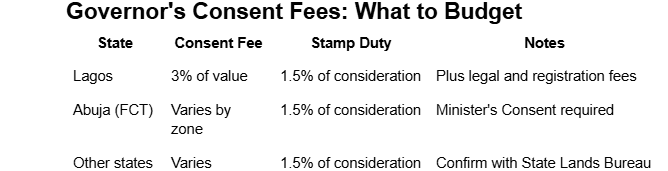
These costs are in addition to legal fees (5–10% of purchase price) and should be discussed and agreed upon between buyer and seller before contracts are signed. In many transactions, the parties negotiate who bears which costs.
Common Mistakes Buyers Make With Governor's Consent
Assuming the developer or agent will handle it automatically. Unless this is explicitly stated and contracted, it may not happen. Always confirm in writing who is responsible for obtaining consent and by what deadline.
Not budgeting for it. The 3% consent fee in Lagos is substantial on a high-value property. Discovering it after completion can cause significant financial strain.
Accepting a property without confirming it was obtained in previous transactions. If a C of O was issued in 2005 and the property has changed hands three times since, Governor's Consent should have been obtained for each transfer. A land search at the registry will reveal whether it was.
Delaying the application. Some buyers take possession and assume they can sort the paperwork later. The longer it is delayed, the more complicated and expensive it can become, particularly if circumstances change for either party.
How Reputable Developers Handle This
When you purchase from a reputable Nigerian property developer, the title transfer process, including Governor's Consent, is a defined part of the transaction. Professional developers:
- Build on land with clean, verified title from the outset
- Make all title documents available before any payment is made
- Clearly define in the Sale and Purchase Agreement who is responsible for obtaining consent and registration
- Guide buyers through every document before signature
This is one of the most important distinctions between buying from a credible developer and buying privately through an unregulated agent.
Final Word
Governor's Consent is not optional. It is not a technicality. It is the legal mechanism through which a property transaction becomes real in the eyes of Nigerian law.
If you are buying property in Nigeria, whether a land plot, an apartment, or a commercial unit, make sure Governor's Consent is part of your transaction from day one. If you are buying a property that has been previously sold, make sure it was obtained for every prior transfer.
Questions about your specific transaction? Speak with the Leisure Court advisory team; we walk every buyer through the documentation before they sign.
Related Articles:
- What is a Certificate of Occupancy in Nigeria?
- How to Verify Property Title in Lagos State
- 5 Documents You Must See Before Buying Property in Nigeria
Ready to take the next step in your property journey?
Explore verified projects from Leisure Court or begin your purchase process.
Start nowFrequently asked questions
More in Buyer's Guide
 Buyer's Guide
Buying in Lekki: What You Need to Know
Lekki is Lagos' most active real estate corridor and one of Nigeria's most misunderstood. Prices range from accessible to extraordinary; titles range from bulletproof to deeply problematic; and the area is developing so fast that decisions made without up-to-date information can be costly.
Read More Buyer's Guide
Commercial Real Estate Opportunities in Nigeria 2026
Commercial real estate in Nigeria is frequently overshadowed by the residential market in public conversation, but for informed investors, it offers some of the most compelling yield and appreciation opportunities available in the country.
Read More Buyer's Guide
Off-Plan vs Ready-Built Property in Nigeria: Which Is Right For You?
Two buyers with identical budgets can make very different decisions and both be right; if they are buying for the right reasons. Off-plan and ready-built properties represent fundamentally different risk and return profiles.
Read More Buyer's Guide
Diaspora Real Estate Investment: Practical Steps
This guide gives you a practical, honest roadmap for navigating the process from wherever you are in the world.
Read More