
If you are buying property in Nigeria, four words will come up in almost every conversation: Certificate of Occupancy. Shortened to C of O, this document is the gold standard of land title in Nigeria and understanding it is non-negotiable before you commit a single naira to any transaction.
This guide explains what a C of O is, what it covers, how to verify one, and what happens when a property does not have one.
Leisure Court Editorial Team
Real Estate and Property Development, Nigeria
Leisure Court has been developing affordable residential estates across Abuja, Lagos, Akure and Osogbo for over 7 years. Our team writes to help Nigerian buyers make informed real estate decisions.
What this article covers
Why Land Ownership in Nigeria Works Differently
To understand the C of O, you first need to understand how land ownership works in Nigeria.
Under the Land Use Act of 1978, all land in Nigeria is vested in the Governor of each state. This means no individual truly "owns" land in the conventional sense. Instead, individuals and organisations hold a right of occupancy, permission from the state to use and develop land for a defined period.
A Certificate of Occupancy is the formal document that records and proves that right.
What Is a Certificate of Occupancy?
A Certificate of Occupancy is an official document issued by a State Governor (or the FCT Minister in Abuja) that grants the holder a statutory right of occupancy over a piece of land for up to 99 years.
It contains:
- The name of the holder
- A description and survey plan of the land
- The permitted use (residential, commercial, agricultural)
- The term of the grant
- Conditions attached to the occupancy
- The signature and seal of the issuing authority
It is registered at the State Land Registry, which means it can be searched, verified, and transferred through a formal legal process.
Why the C of O Matters So Much
The C of O matters because it is the strongest form of land title available in Nigeria. Properties with a C of O:
- Are easier to sell and transfer legally
- Can be used as collateral to secure bank loans and mortgages
- Have a clear, searchable ownership history
- Are less likely to be subject to competing claims or family disputes
- Carry significantly higher market value than properties with weaker documentation
When you work with a trusted real estate developer in Nigeria, one of the first things they will confirm is the title status of any land they develop. Developers who operate with integrity build only on land with clean, verified documentation, and they make that documentation available to buyers before any money changes hands.
What Happens When a Property Does Not Have a C of O?
Not all properties in Nigeria have a Certificate of Occupancy. Many legitimate transactions involve properties with alternative documents, but each carries a different level of risk:
- Deed of Assignment — Used to transfer ownership of land that has not yet been registered with a C of O. Must be stamped and registered to be valid, but offers weaker protection than a C of O.
- Registered Survey Plan — Confirms the boundaries of the land but does not confer a right of occupancy. Should always accompany a C of O or Deed of Assignment, not substitute for them.
- Family Receipt / Agreement of Sale — Common in informal transactions, particularly on family land. These carry the highest risk — family disputes and multiple claims are extremely common.
- Governor's Consent — Required whenever a property with an existing C of O changes hands. Without it, the transfer is legally invalid even if money has been paid and keys exchanged.
If a seller cannot produce a C of O or a Governor's Consent (for previously titled land), engage an independent property lawyer before proceeding. A land search at the State Land Registry will reveal the true status of the title.
How to Verify a Certificate of Occupancy in Nigeria
Verification is a non-negotiable step. Forged C of O documents exist, and fraudsters have used them to defraud buyers of significant sums.
Here is how to verify authenticity:
1. Conduct a Land Search at the State Registry; Visit the relevant State Land Registry (e.g., Lagos State Land Registry in Alausa, Ikeja, or the FCT Land Administration for Abuja properties). Submit a formal search request with the C of O number and plot details. The registry will confirm whether the document is genuine and whether any encumbrances or government acquisition notices are registered against it.
2. Cross-check the Survey Plan; The survey plan attached to the C of O should match official survey records. An independent licensed surveyor can verify this.
3. Confirm the Holder's Identity; The name on the C of O must match the identity of the person selling to you. If they differ, a valid Governor's Consent for the transfer must be in place.
4. Check for Encumbrances The land search will reveal whether the property has been used as loan collateral, is subject to a government acquisition order, or has any legal disputes attached to it.
C of O in Lagos vs. Abuja: Key Differences
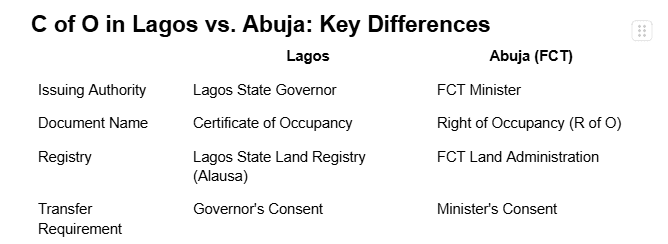
The Right of Occupancy in Abuja functions identically to a C of O, the difference is in name and issuing authority only.
Questions to Ask Before Buying Any Property in Nigeria
Before signing anything or making any payment, ask:
- Does this property have a C of O or R of O?
- If the C of O is in a previous owner's name, has Governor's Consent been obtained for all transfers?
- Has a land search been conducted at the State Registry recently?
- Is there a registered survey plan that matches the C of O?
- Are there any encumbrances, mortgages, or government acquisition notices on the title?
A reputable Nigerian real estate developer will welcome every one of these questions. Developers who hesitate, rush you, or discourage due diligence are the ones to walk away from.
Final Word
The Certificate of Occupancy is not a bureaucratic formality; it is the legal foundation of your investment. Buying property in Nigeria without verifying the title is one of the most common and costly mistakes buyers make.
Take the time to verify. Engage a qualified property lawyer. Work with developers who build on properly titled land and provide full documentation to every buyer.
If you are looking at property in Abuja, Lagos, Akure, or Osogbo and want to understand the exact title status of what you are buying, speak with the Leisure Court advisory team before you proceed.
Related Articles:
Ready to take the next step in your property journey?
Explore verified projects from Leisure Court or begin your purchase process.
Start nowFrequently asked questions
More in Buyer's Guide
 Buyer's Guide
Buying in Lekki: What You Need to Know
Lekki is Lagos' most active real estate corridor and one of Nigeria's most misunderstood. Prices range from accessible to extraordinary; titles range from bulletproof to deeply problematic; and the area is developing so fast that decisions made without up-to-date information can be costly.
Read More Buyer's Guide
Commercial Real Estate Opportunities in Nigeria 2026
Commercial real estate in Nigeria is frequently overshadowed by the residential market in public conversation, but for informed investors, it offers some of the most compelling yield and appreciation opportunities available in the country.
Read More Buyer's Guide
Off-Plan vs Ready-Built Property in Nigeria: Which Is Right For You?
Two buyers with identical budgets can make very different decisions and both be right; if they are buying for the right reasons. Off-plan and ready-built properties represent fundamentally different risk and return profiles.
Read More Buyer's Guide
Diaspora Real Estate Investment: Practical Steps
This guide gives you a practical, honest roadmap for navigating the process from wherever you are in the world.
Read More