
Buying land in Abuja is one of the smartest financial decisions a Nigerian can make in 2026. The Federal Capital Territory continues to attract infrastructure investment, diaspora buyers and government-backed development, which means land values in areas like Lugbe, Karsana, Guzape and Idu are appreciating steadily year on year. But buying land in Abuja is also one of the easiest ways to lose a significant amount of money if you do not know what you are doing.
Leisure Court Editorial Team
Real Estate and Property Development, Nigeria
Leisure Court has been developing affordable residential estates across Abuja, Lagos, Akure and Osogbo for over 7 years. Our team writes to help Nigerian buyers make informed real estate decisions.
What this article covers
Every year, thousands of Nigerians lose their savings to fake developers, disputed titles and estates that are never delivered. The buyers who get burned are rarely naive. They are hardworking people who simply did not know which questions to ask or which documents to verify before they paid. This guide exists to change that. Here are the seven most costly mistakes buyers make when purchasing land in Abuja and the practical steps to avoid every single one of them.
Key fact: The Economic and Financial Crimes Commission (EFCC) regularly reports real estate fraud as one of the most common financial crimes in Nigeria. Most victims made their payments without completing basic verification steps.
Mistake 1: Buying From a Developer You Have Not Verified
The first and most costly mistake Abuja land buyers make is paying money to a developer or seller whose track record they have not investigated. In Nigeria's real estate market, anyone can present as a developer. A polished Instagram profile, a professional website and glossy project renders do not confirm that a company has ever delivered a completed estate.
Before you pay a single naira, you need to answer these questions about any developer you are considering:
- Is the company registered with the Corporate Affairs Commission? Verify at cac.gov.ng using the company name.
- Is the company a member of the Real Estate Developers Association of Nigeria (REDAN)? Membership requires a level of accountability that unregistered operators do not have.
- Can you visit their physical office? A developer with no verifiable address is a serious red flag.
- Can you visit at least one of their previously completed estates? Speak to actual homeowners there. Ask them about the delivery process, title documentation and after-sales support.
- How long have they been operating? A developer who has been active for 5 or more years with a portfolio of completed projects has demonstrated something that newer operators have not.
Verify any Nigerian company registration at the Corporate Affairs Commission portal.
Leisure Court has been operating for over 7 years with more than 20 completed estates across Abuja, Lagos, Akure and Osogbo. Learn more about our history and track record.
Red flag: Any developer who refuses to provide their CAC registration number or cannot take you to a completed estate should not receive your money.
Mistake 2: Not Verifying the Land Title Before Paying
Land title verification is the single most important step in any Abuja property purchase, and it is the step most buyers either skip entirely or perform inadequately. A title document tells you who legally owns the land, whether the government has approved it for residential use and whether there are any existing disputes or encumbrances on it.
These are the title types you will encounter in Abuja and what each one means:
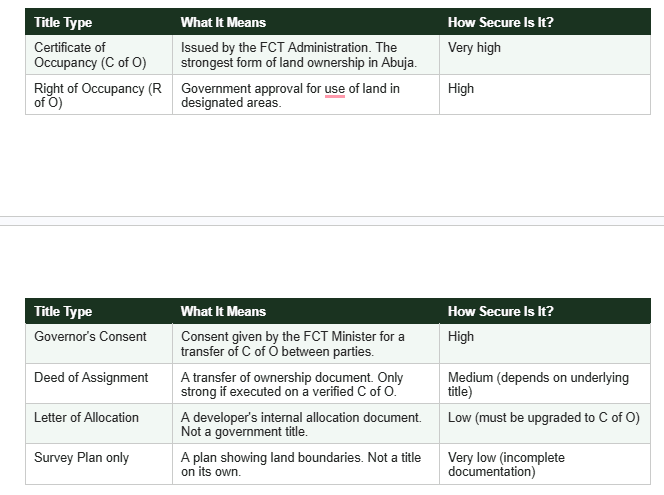
Always request copies of the title documents before paying and have them verified independently. You can use the FCT Geographic Information Systems Agency (AGIS) to verify land titles in Abuja. Do not accept a developer's word that the title is clean. Verify it yourself or through a lawyer.
The Abuja Geographic Information Systems Agency (AGIS) handles land title verification for FCT properties. Contact them at agis.fcta.gov.ng.
Red flag: Any developer who cannot or will not share title documentation before you pay is not operating transparently. Move on.
Mistake 3: Relying on Photos and Renders Instead of Visiting the Site
In an era of high-quality 3D renders and drone photography, it has become very easy for developers to present projects that look far more developed than they actually are. Some fraudulent operators use images of completely different locations or fabricated CGI renders to sell land that either does not exist or is nowhere near the described location.
Physical site inspection is non-negotiable. Before you pay, you must visit the land yourself or send a trusted representative. During your site visit, you should confirm:
- The exact location matches what was described. Check against Google Maps and confirm road access.
- The environment and surroundings match what was advertised. Is it genuinely a developing residential area or a remote plot with no infrastructure?
- Development status: Is the estate being actively developed? Are roads being constructed? Is perimeter fencing in place?
- Neighbouring estates: Are there other established or developing estates nearby? This is a strong indicator of genuine growth in the area.
- Flood risk: Is the land on low ground? Does water pool in the area during rainy season? Flood-prone land in Abuja is extremely difficult to develop and resell.
For diaspora buyers who cannot travel to Nigeria for a site visit, ask the developer to arrange a live video walk-through of the specific plot and its surroundings. A legitimate developer will have no objection to this request.
Mistake 4: Not Getting the Full Cost Breakdown in Writing
Many buyers focus entirely on the land price and are then blindsided by additional costs they were not told about upfront. In some cases, these undisclosed costs can add 15 to 30 percent to the total purchase price. Always request a complete written cost breakdown before signing anything or making any payment.
The full cost of buying land in Abuja typically includes:
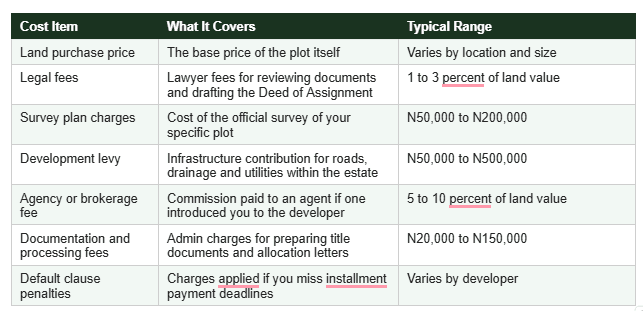
Any legitimate developer should be able to provide this breakdown in writing before you pay. If a developer is vague or evasive about any of these costs, treat that as a warning sign.
Important: Always read the payment default clauses in any installment agreement. Some developers charge significant penalties for late payments or reserve the right to reallocate your plot if payments are missed.
Mistake 5: Skipping Legal Review Before Signing
Most Abuja land buyers do not involve a lawyer until after something goes wrong. At that point, the legal fees are much higher and the chances of recovery are much lower. Involving a qualified property lawyer before you sign any document or make any payment is one of the most important investments you can make in any property transaction.
A property lawyer will review:
- The title documents to confirm ownership and check for any existing charges or disputes
- The sales agreement or offer letter to check for unfair clauses, hidden fees and delivery obligations
- The developer's company documentation to confirm they are legally registered and authorised to sell the land
- Any previous transactions on the plot to confirm there are no double-allocation issues
Legal fees for a straightforward land purchase review typically range from N50,000 to N200,000 depending on the complexity of the transaction and the lawyer's experience. This is a small cost compared to the potential loss of your entire investment.
The Nigerian Bar Association maintains a directory of qualified property lawyers. Visit nigerianbar.org.ng to find a registered lawyer in Abuja.
Mistake 6: Not Collecting All Post-Payment Documents
Many buyers complete their payments and then fail to collect all the documentation they are entitled to. This is a mistake that can cause serious problems years later when you want to sell, develop or use the property as collateral for a loan. After every payment, you should collect and safely store the following documents:
- Official receipt for every payment made, on company letterhead
- Signed copies of the purchase agreement or offer letter
- Letter of allocation from the developer
- Survey plan for your specific plot
- The Deed of Assignment (executed after full payment in most cases)
- Any government approval documentation related to the estate
Do not accept verbal assurances that documents will be provided later. Every document should be collected as it becomes due, signed and kept in a secure location. For diaspora buyers, scanned certified copies sent digitally are acceptable as a starting point but originals should eventually be held by a trusted representative in Nigeria.
Mistake 7: Making Payments Without a Formal Agreement
This is arguably the most preventable mistake and still one of the most common. Some buyers pay deposits or even full purchase prices to developers based on verbal agreements, WhatsApp conversations or informal meetings. Without a signed formal agreement, you have no legally enforceable claim on the land regardless of how much money you have paid.
Before any payment, even a small initial deposit, insist on receiving a signed offer letter or purchase agreement that clearly states:
- The exact plot details including estate name, plot number and size in square metres
- The total agreed purchase price
- The payment schedule and due dates for each installment
- The developer's obligations including infrastructure delivery and documentation timelines
- The conditions under which either party can exit the agreement
- The dispute resolution process if something goes wrong
Any developer who is reluctant to provide a formal written agreement before accepting payment is not operating with the transparency that a transaction of this size deserves.
One way to avoid this entirely is choosing a reputable Nigerian developer with completed projects you can physically verify
If you suspect you have been defrauded by a property developer in Nigeria, the Economic and Financial Crimes Commission (EFCC) accepts complaints at efcc.gov.ng.
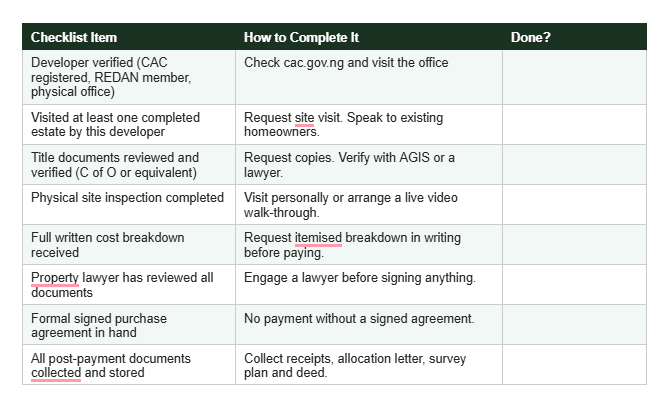
The Safe Land Buying Checklist for Abuja
Use this checklist before making any payment for land in Abuja. If you cannot check every box, pause the transaction until you can.
How to Compare Verified Abuja Properties Before You Decide
One of the safest ways to reduce risk when buying land in Abuja is to work with a developer who has a verifiable track record, transparent pricing and a clear documentation process. Before you commit to any purchase, compare options from developers who can demonstrate all of the above.
Browse verified land and property options across Abuja before making your decision. View Leisure Court Abuja Projects.
Leisure Court has been delivering verified residential estates in Abuja for over 7 years. Every estate comes with a verified land title, a transparent payment plan and dedicated after-sales support. Active Abuja projects include Victory Park in Lugbe, Leisure Gardens in Karsana, Knightsbridge in Kaura, Panorama Hills in Guzape, Spring Estate in Idu and Citadel in Lifecamp.
Ready to buy land in Abuja with confidence? Our team is available to walk you through every step. Book a free consultation at Leisure Court.
Ready to take the next step in your property journey?
Explore verified projects from Leisure Court or begin your purchase process.
Start nowFrequently asked questions
More in Buyer's Guide
 Buyer's Guide
Buying in Lekki: What You Need to Know
Lekki is Lagos' most active real estate corridor and one of Nigeria's most misunderstood. Prices range from accessible to extraordinary; titles range from bulletproof to deeply problematic; and the area is developing so fast that decisions made without up-to-date information can be costly.
Read More Buyer's Guide
Commercial Real Estate Opportunities in Nigeria 2026
Commercial real estate in Nigeria is frequently overshadowed by the residential market in public conversation, but for informed investors, it offers some of the most compelling yield and appreciation opportunities available in the country.
Read More Buyer's Guide
Off-Plan vs Ready-Built Property in Nigeria: Which Is Right For You?
Two buyers with identical budgets can make very different decisions and both be right; if they are buying for the right reasons. Off-plan and ready-built properties represent fundamentally different risk and return profiles.
Read More Buyer's Guide
Diaspora Real Estate Investment: Practical Steps
This guide gives you a practical, honest roadmap for navigating the process from wherever you are in the world.
Read More